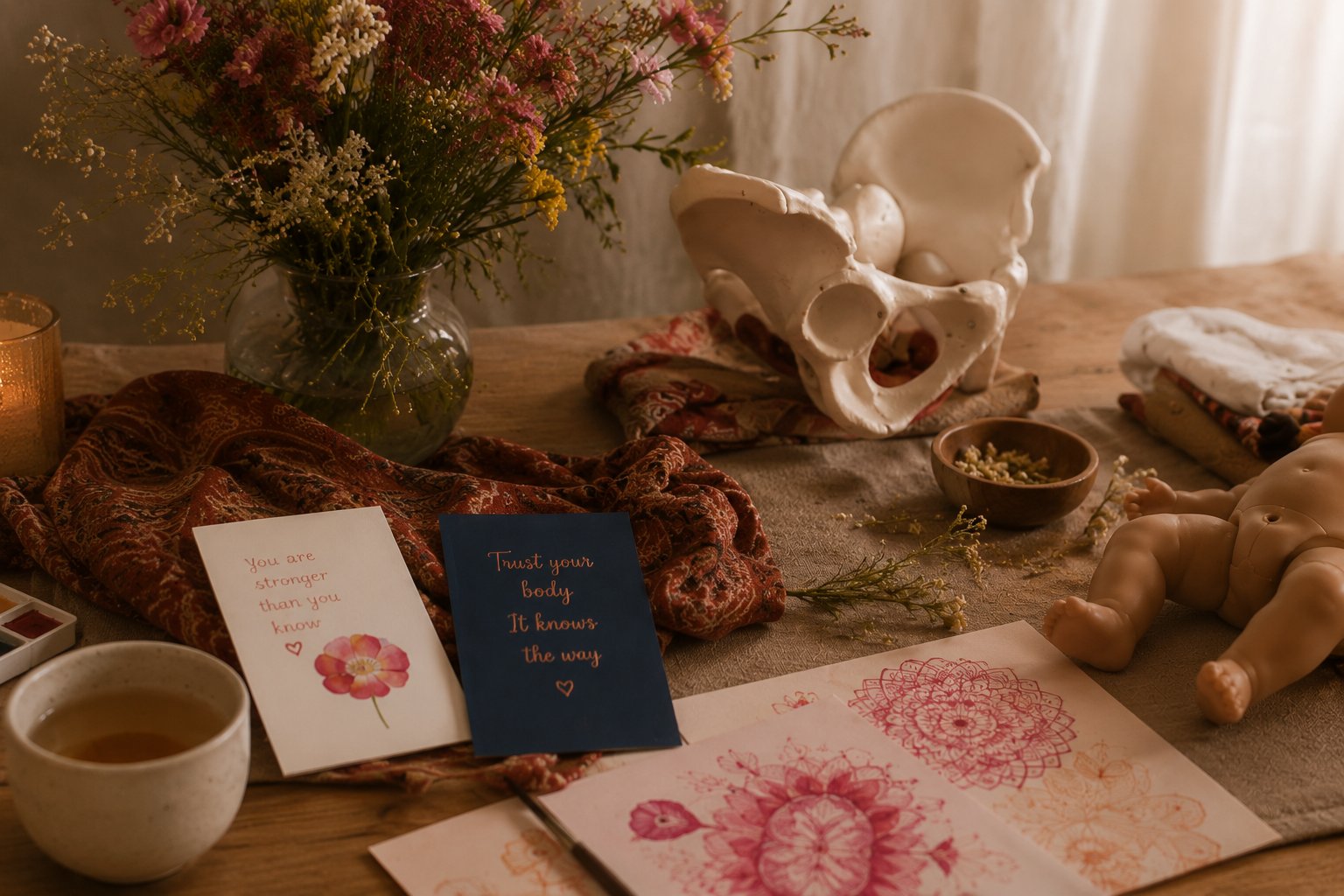
We often prepare for birth by learning what will happen to our bodies. We learn about contractions and the stages of labour, pain relief, birth positions, medical options, what to take to hospital and what to expect in those first hours with our baby. All of this can be valuable.
But birth is more than a physical event. Preparing for it can also mean preparing for the transition that is happening in our lives.
A baby is not the only one being born.
A mother is being born too.
This is what I mean when I describe birth as a rite of passage.
A rite of passage marks a significant transition in our lives. It recognises that we are crossing from one stage into another, and that we may not be quite the same on the other side.
Birth does this in a very real way. We give birth to our children, while also entering motherhood — with all the changes in body, identity, relationships, responsibility and daily life that this can bring.
Across cultures and throughout history, birth and the transition into motherhood have been marked in many different ways through ritual, community and care. What these practices looked like varied enormously, but many held a recognition that the person giving birth was also going through a profound transition.
I think something important can be lost when this part of birth becomes invisible.
In many modern birth systems, childbirth has increasingly come to be approached primarily as a medical event. Medical care can be enormously important and, at times, lifesaving. Recognising birth as a rite of passage does not mean rejecting that care.
But when birth is understood mainly through what needs to be monitored, managed or treated, the experience of the woman herself can easily move into the background. Her body can begin to feel like something being managed. Her choices can become secondary. And the enormous transition she is living through may receive very little attention.
This is why it matters to me to reconnect women with birth as a rite of passage.
Not because your birth needs to be spiritual, ceremonial or beautiful. And certainly not because it should happen in one particular way.
Your birth may be straightforward or complicated, physiological or highly medicalised, close to what you hoped for or completely different. None of this takes away from the significance of what you are going through.
The rite of passage is the transition itself.
The transition into motherhood is often described as matrescence. It begins during pregnancy and continues well beyond birth. Like adolescence, it can involve profound physical, emotional and social change, as well as changes in the brain as we adapt to caring for a baby.
Your relationship with your body may change. So may your relationships with other people, your independence, your priorities and your understanding of yourself.
And then there is your baby — a completely new person whose arrival changes the shape and rhythm of your life.
I hear and read many women who have given birth speak about the enormity of this change.
I gave birth myself at 36, and looking back, my birth feels like a great opening in my life. It asked me to put aside — or perhaps let go of — some of my girlhood dreams, ambitions and ideals, and to make space for the more complex experience of becoming a mother and a growing woman.
Motherhood did not arrive neatly at the moment my baby was born. I had to grow into it. And in many ways, I am still growing into the woman that experience asked me to become.
When we see birth only as something to get through safely, another kind of preparation can easily be missed. Not simply preparing to give birth, but preparing ourselves for the changes that becoming a mother may bring. For me, this is where recognising birth as a rite of passage becomes practical.
Alongside the usual questions about labour and birth, you might begin to ask yourself:
Who do I want around me when I give birth?
What helps me feel safe enough to listen to my body and stay connected to myself?
How would I like my partner to support me — during birth, and afterwards?
Who will care for me once my baby is here?
What might I need in those first weeks, when so much attention naturally turns towards my baby?
Who can I call when I am tired, overwhelmed, uncertain or simply need someone to be with me?
What practical, emotional or physical support can I begin putting around myself now?
What am I already carrying into motherhood — expectations, fears, hopes, ideas about what a “good mother” should be?
What might I need to let go of? And what do I want to carry forward?
These questions do not need immediate answers. They are invitations to begin noticing.
Because preparing for birth is not only about making a plan for labour. It can also be about creating some space around the woman who is entering this new territory.
It might mean talking with your partner about what support could look like. It might mean asking for help before you think you need it. It might mean building relationships with people who can care for you as well as your baby. It might mean allowing yourself to imagine that the weeks after birth deserve preparation too.
And it means making room for the reality that becoming a mother can hold many experiences at once: love and exhaustion, joy and grief, tenderness and uncertainty, wonder and overwhelm.
None of this means turning birth into a ceremony or making motherhood into something sacred that you are expected to experience in a particular way.
A rite of passage is not another ideal to live up to.
It is simply a way of recognising the magnitude of what is happening — and giving that transition some attention and care.
Perhaps this is the part I most want us to reclaim. Not an idealised version of birth. Not the idea that you should somehow be able to do it all through instinct or strength alone. But the recognition that something significant is happening to you too.
Your experience matters.
Your choices matter.
Your recovery matters.
And the woman you are becoming matters.
Birth is not simply an event at the end of pregnancy.
It is a threshold into a new part of your life.
And when we recognise it as such, maybe then we begin to make more room for the mother — not only during birth, but in the days, weeks and months that follow. For her recovery, her need for rest and nourishment, her emotions and questions, her changing relationships, her need to be cared for while she learns to care for someone else. For the parts of herself she may be discovering, losing, grieving or growing into.
Because the baby needs care.
And so does the woman who has just given birth.
Perhaps preparing for birth can begin with making space for both.
Irida Hysenbelli — Rite of Passage Doula